This section provides guidance on safeguarding plans regarding Section 42 enquiries (Care Act 2014).
Once the safeguarding enquiry has been completed the Managing Officer will consider the level of risk and determine when any further action or intervention is needed to protect the adult. If there is still a medium or high risk of ongoing harm then a safeguarding plan should be developed to identify how this is to be mitigated.
This section provides guidance on developing, implementing and reviewing
safeguarding plans.
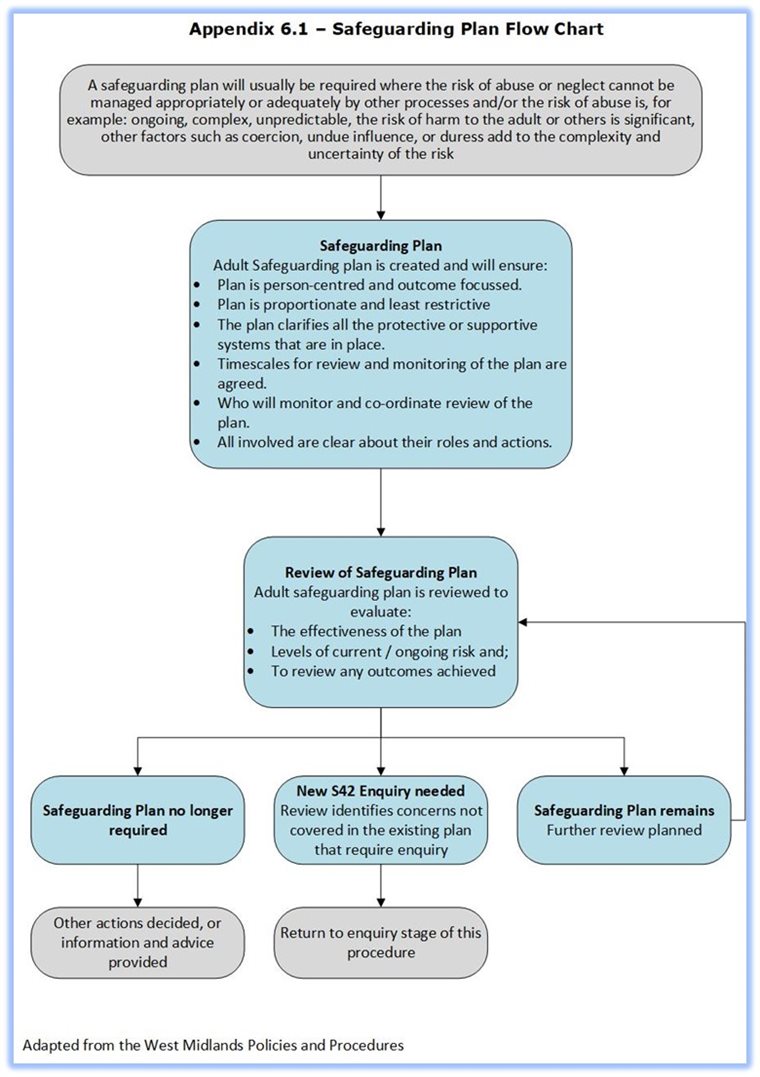
Refer to Appendix 6.1 for a Safeguarding Plan Flow Chart
6.1 A safeguarding plan will usually be required where the risk of abuse or neglect cannot be managed appropriately or adequately by other processes and/or the risk of abuse is, for example:
- Ongoing.
- Complex.
- Unpredictable.
- The risk of harm to the adult or others is significant.
- Other factors such as coercion, undue influence, or duress add to the complexity and uncertainty of the risk.
6.2 These types of situations will require a greater level of scrutiny and review, usually within a multi-agency context.
6.3 A safeguarding plan is the document that clarifies all the protective or supportive systems that are in place, irrespective of who provides these and sets them out as steps towards a defined outcome.
6.4 The safeguarding plan will clearly identify what the objectives and safety goals are, who will be responsible for each aspect, who will co-ordinate the plan, communication arrangements and when it will be reviewed.
6.5 The safeguarding plan will identify any contingency measures that are in place and how they will be triggered. The plan should consider likely future events as far as these can be reasonably anticipated. In each case it should be considered whether there will be a benefit in sharing the safeguarding plan with another professional/agency even where they are not directly involved in the plan, for example the adults GP or Police. This decision must be made on an adult’s individual circumstances and must take into account the issues of proportionality and consent.
6.6 A safeguarding plan is not a care plan, and it will focus on care provision only in relation to the aspects that provide protection or mitigate the risk of abuse.
6.7 Where the adult has mental capacity to understand any potential risks, they should be involved in the development of their safeguarding plan to ensure that it meets their outcomes (as much as possible).
6.8 If the adult has mental capacity but does not consent to the safeguarding plan, then all efforts should be taken to identify steps that would be acceptable. The agreement or acceptance of the adult will be recorded if they have the mental capacity to make that decision. Any offers of support that have been rejected should be clearly recorded as well as the details of alternatives offered or other mitigating action that has been considered.
6.9 In a small number of cases of very high risk where it is believed that the adult is acting under undue influence or is otherwise prevented from protecting themselves there may be a need for a safeguarding plan to be completed without the adult’s consent. Further, there may be consideration of an application to the High Court to use its inherent jurisdiction to determine or enforce necessary protective measures.
6.10 Where the adult lacks mental capacity to understand and consent to the protective measures then these can only be put in place in accordance with the principles of the Mental Capacity Act 2005.
6.11 Where the adult lacks mental capacity and where they or others dispute that an intervention is in their best interests this should be discussed and considered carefully. If the disagreements cannot be resolved, then consideration must be given to referring the matter to the Court of Protection (CoP).
Case scenario: Making a decision to settle disagreements.
Mr Hall has Alzheimer’s dementia. Mr Hall lives with his son, Andrew, but professionals are worried that Andrew is not able to meet his father’s needs effectively. Andrew has consistently declined support from health and social care professionals and there have been a number of safeguarding concerns raised leading to the implementation of a safeguarding plan.A social worker has assessed that Mr Hall does not have capacity to make a decision about his accommodation or how his care and support needs should be met. After considering all least restrictive options, a decision is made that it is in Mr Hall’s best interests to be supported in 24 hour care. However, Andrew does not agree with this decision and wants to continue supporting his father at home.As the disagreement cannot be resolved, an application is made to the Court of Protection. The Court makes the decision that it is in in Mr Hall’s best interests to move to a care home.
6.12 Safeguarding plans can cover a wide range of interventions and should be as innovative as is helpful for the adult. Staffordshire County Council and Stoke-on-Trent City Council each have their own templates available which can be used for recording safeguarding plans. However, any plan should made available in a format suitable for the adults needs.
6.13 Refer to Appendix 6.2 – Short Practice Guide - Examples of positive actions for adult safeguarding plans.
6.14 Each safeguarding plan will have an identified person whose role is to co-ordinate the plan and ensure that there is good communication and effective co-operation. If the plan is not effective the co-ordinating worker will arrange a Safeguarding Plan Review Meeting to address this.
6.15 Individuals/agencies who have defined responsibilities for any actions outlined in the safeguarding plan must ensure that these are documented in their own records. They must make the safeguarding plan co-ordinator aware of any decision to withdraw their involvement and this should instigate a review of the plan to ensure that it does not have an adverse effect on the risk of harm.
6.16 The safeguarding plan must be regularly reviewed (within a maximum of 3 months) to ensure that the protective measures are still relevant and effective in helping to achieve to adult’s desired outcomes.
6.17 A review must take place if any part of the safeguarding plan is discontinued or where the adult rejects any planned intervention or support that had previously been agreed.
6.18 Safeguarding plans should not rely exclusively on professional sources of support. Where it is possible to involve family, friends and community networks in supporting an adult this may offer a good basis for long term protection.
6.19 Where there is a formal legal framework underpinning the safeguarding plan (for example, bail conditions, detention under the Mental Health Act or Domestic Violence Prevention Orders) then the Safeguarding Plan Co-ordinator will need to remain aware of any relevant timescales. The plan should also detail any contingency plans that may be in place for the termination of these processes.
6.20 Where there are concerns for other people, especially others in the adult’s household, the safeguarding plan should make clear how the communication arrangements will work between the respective workers and what the relationship will be between the safeguarding plan and any other measures in place to protect others (e.g. child protection orders; Deputyship).
6.21 There will be instances where professionals may disagree on whether action is required or on the appropriate level of intervention. It is essential that any disagreements are resolved professionally through constructive dialogue and a willingness to consider other points of view. Please refer to Section 4, 4.41 – 4.44 Resolving Disagreements for further information.
Safeguarding Plan Review Meeting
6.22 The person who is co-ordinating the safeguarding plan will arrange the meeting and will ensure that all those who contribute to the safeguarding plan are invited. An agenda for the Safeguarding Plan Review Meeting can be found at the end of this section (Appendix 6.3).
6.23 The Safeguarding Plan Review Meeting will be held within 3 months after the implementation of a safeguarding plan and will review the arrangements against the desired outcomes and the risk of harm. This meeting will also consider any variations to the safeguarding plan and also the withdrawal of any participating individual/agency.
6.24 The Safeguarding Plan Review Meeting will be formally recorded and will include a clear action plan. The action plan and minutes should be shared in a timely way.
6.25 Any person involved in the safeguarding plan can request a review. A Safeguarding Plan Review Meeting may be called at any time that it is felt necessary to bring together those who are named in the safeguarding plan.
6.26 No one should end their involvement in the safeguarding plan without notifying the Safeguarding Plan Co-ordinator. Where an agency or professional is considering withdrawing their involvement this should be considered as grounds for a Review Meeting.
6.27 If the adult moves to another authority or goes abroad the co-ordinator of the safeguarding plan will seek to ensure that all relevant information is shared with the appropriate agencies to mitigate any risks that are known of or can be anticipated.
Ending of a Safeguarding Plan
6.28 The safeguarding plan will not be required when it is agreed that the risk of harm to the adult is no longer current. This may because, for example, the source of risk has no further involvement in the adult’s support. Alternatively, the safeguarding plan may end when risks have reduced to a level that can be managed or monitored through single agency processes, e.g. assessment and support planning processes, community policing responses, health service monitoring.
6.29 The plan may also end if the adult (with capacity) withdraws consent to the arrangements and is not prepared to accept other support or protection. In a small number of cases of very high risk where it is believed that the adult is acting under undue influence or is otherwise prevented from protecting themselves there may be a need for a safeguarding plan to be completed without the adult’s consent.
6.30 Ending of the safeguarding plan will be communicated to the adult and/or their representative and all others who are involved in the plan.
6.31 The ending of the safeguarding plan will be recorded on the Local Authority’s social care record system. The outcome of the plan will also be recorded.
Appendixes
Download Appendicies
| Actions to promote the safety and wellbeing of an adult, and for resolution & recovery from the experience of abuse or neglect. | Actions to prevent further abuse or neglect by a person or an organisation. |
|---|
| Provision of care and support services (e.g., homecare, telecare) |
Reassessing and changing support provision for an adult with care & support needs who poses a risk of harm to other service users |
| Security measures (e.g., door locks, entry devices, personal alarms, telephone or pager, CCTV) |
Carrying out a carers assessment and providing services to decrease risk of harm |
| Flags on agency systems (e.g., markers on Police systems for priority response) |
Change of support services provided to an adult to decrease carer stress |
| Education and guidance to increase self-protection (e.g., The Freedom Programme, information on door-step crimes) |
Increased observation and appropriate interventions to prevent harmful behaviour by other service users |
| Support or activities that increase self-esteem and confidence |
Meeting with an individual who poses a risk of harm and negotiating changes to their behaviour |
| Advocacy services |
Family group conferencing/mediation to consider changes to behaviour that present a risk of harm |
| Counselling and therapeutic support |
Criminal prosecution |
| Mediation or family group conferencing |
Enforcement action by CQC, including cancellation of registration |
| Domestic abuse support services |
Application for a Court Order (e.g., restraining contact, anti-social behaviour order) |
| Restorative justice |
Application to the Court of Protection to change/remove a Lasting Power of Attorney |
| Circles of support |
Application to the Department of Work and Pensions to change/cancel appointeeship |
| Befriending |
Civil Law remedies (e.g., suing for damages) |
| Blocking nuisance calls or advice from Trading Standards |
Prosecution by Trading Standards |
| Neighbourhood watch |
Referral to the relevant registration body (e.g., Nursing and Midwifery Council, Social Work England, General Medical Council) |
| Application for Criminal Injuries Compensation |
Training needs assessment, supervision (of employee/volunteer), or disciplinary action following an internal investigation |
| Appointeeship |
Organisational review (e.g., staffing levels, policies/procedures, working practices, culture) |
| Application to the Court of Protection for single decision or court-appointed deputy |
Referral to Disclosure and Barring Service |
| Application to the High Court under inherent jurisdiction |
|
| Domestic abuse prevention orders, forced marriage prevention orders |
|
| Civil injunctions |
|
| Guardianship order under the Mental Health Act (e.g., to require residence or access) |
|
| Support through the Criminal Justice system (e.g., Independent Domestic Violence Advocate, ISVA, Intermediary Service) |
|
| Support to recover from crime and advice on the criminal justice system (e.g., Victim Support) |
|
| Support to make visual evidence for later use if deciding to make a criminal complaint (e.g., Visual Evidence for Victims) |
|
Appendix 6.3 – Safeguarding Plans
Agenda - Safeguarding Plan Review Meeting
- Introduction / Apologies.
- Confidentiality statement: Any information disclosed as part of these discussions should not be shared with any other person unless agreed as a specific action point.
- Purpose of meeting.
- What were the outcomes we were seeking to achieve?
- Detail the progress made against these outcomes from the adult’s point of view.
- Detail the progress against these outcomes from others involved.
- What are the current levels of risk to the adult?
- Is this Safeguarding Plan still required?
- Are there any changes required to the Safeguarding Plan?
- Further review meetings required?
- Action Plan.
- Actions arising from the review.