This section provides guidance on how concerns will be responded to and the decision-making process regarding Section 42 enquiries (Care Act 2014).
The section includes guidance on the following:
Referral points
3.1 Safeguarding concerns will be made to the respective Contact Centres for Staffordshire County Council and Stoke-on-Trent City Council in accordance with the guidance provided in Section 2.
Decision making
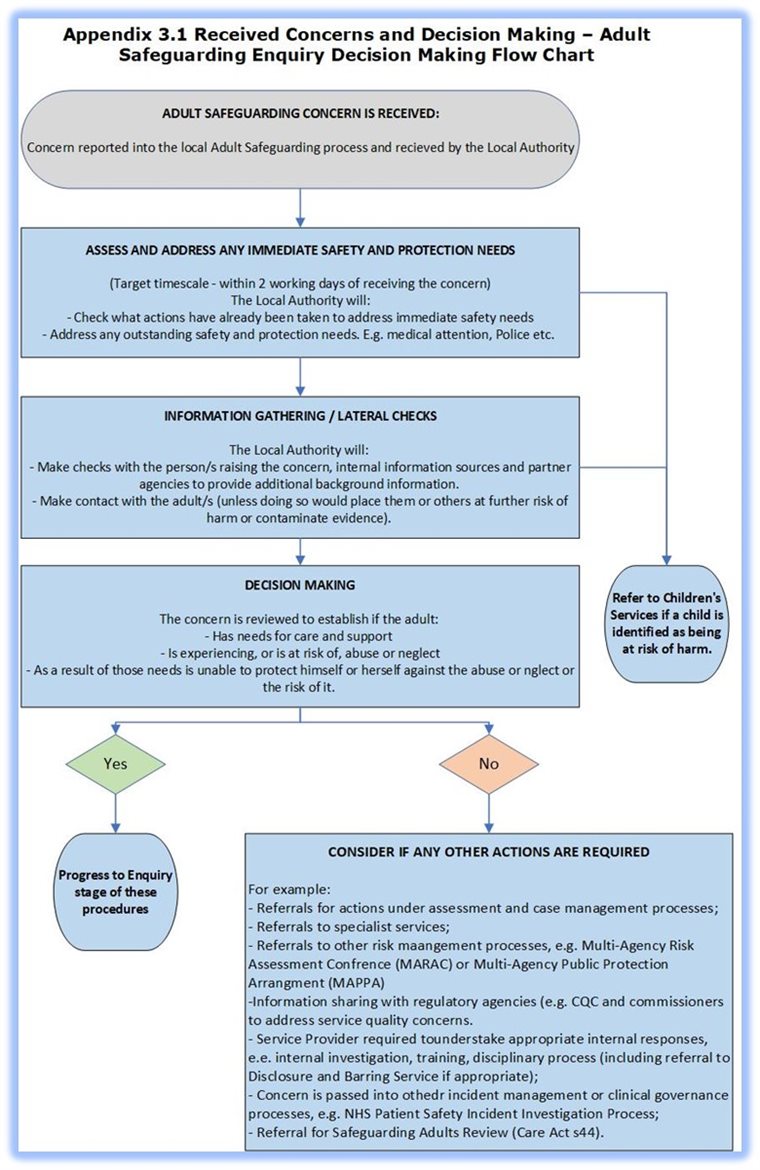
3.2 The concern will be passed on to a Managing Officer who will make a decision as to whether an Enquiry under Section 42 of the Care Act 2014 is to be considered. This decision to undertake an Enquiry will be based upon the following criteria:
- The concern relates to a person who is 18 or over.
- The adult has needs for care and support (whether or not these are being met at this time).
- The adult is experiencing, or at risk of abuse, neglect or self-neglect.
- As a result of the adult’s care and support needs the adult is unable to protect themselves from the risk of abuse or the experience of abuse or neglect.
3.3 In considering the risk of abuse Managing Officers will need to be satisfied that a specific risk has been identified, considered the impact of the abuse/potential abuse and the likelihood of this occurring. A general vulnerability or speculation about potential risks will not be sufficient to justify a Section 42 enquiry. However, in many cases it may trigger an assessment or reassessment of care and support needs under other relevant sections of the Care Act 2014.
Please refer to the Staffordshire and Stoke-on-Trent Adult Safeguarding Decision Making Flowchart (Appendix 3.1)
Historic abuse and deceased adults
3.4 The duty to make enquiry under the Care Act 2014 relates to abuse or a risk of abuse or neglect that is current and therefore allegations of historic abuse will not be the subject of statutory enquiry under these procedures. However, further action under different processes may be needed.
3.5 Similarly, if the adult is no longer at risk of abuse due to having moved elsewhere with no likely return then no statutory enquiry is necessary although the considerations below will apply.
3.6 Where a concern is received for an adult who has died, the same approach will apply and an enquiry will only be made where there is a clear belief that other adults are, or may be, at risk of harm.
3.7 Where there is any level of concern about the circumstances of an adult’s death, this must be reported to the local coroner promptly.
The Coroner for Staffordshire and Stoke-on-Trent can be contacted on:
E-mail staffordshireandstokecoroners@stoke.gov.uk
3.8 All such concerns will be considered to determine whether they demonstrate a potential current risk of harm to other adults and also whether they require criminal or other investigation though parallel processes (refer to Appendix 3.2)
3.9 In any case where there appears to be a current risk to other adults then appropriate steps must be taken to clarify this and to identify the adults who may be at risk. Enquiries under Section 42 can then be considered in respect of those other identified individuals.
3.10 In cases where an adult with care and support needs has died after suffering abuse or neglect and where there is a concern about how agencies worked together to safeguard the adult there is a statutory requirement for the Safeguarding Adults Board (SAB) to undertake a Safeguarding Adult Review (SAR) under Section 44 of the Care Act 2014.
3.11 Under section 44 of the Care Act 2014 the Safeguarding Adults Board (SAB) may also undertake a Safeguarding Adults Review in situations where an adult has suffered serious abuse or neglect and has not died but where there are concerns about how agencies worked together to safeguard them.
3.12 In both the above situations staff who become aware of such a case must report it to their Safeguarding Adults Lead, who may make the appropriate referral to the SAB Safeguarding Adult Reviews 2: Referral form (ssaspb.org.uk)
Self-neglect
3.13 The Care and Support Statutory Guidance to the Care Act 2014 makes it clear that self-neglect is not necessarily to be considered as a cause for enquiry under Section 42.
3.14 Managing Officers will consider concerns relating to self-neglect cases to confirm that the following factors apply:
- There is a clear current risk to the adult (and potentially others) of immediate serious harm.
- An assessment of care and support needs has already been undertaken or attempted.
- A care or treatment plan has been proposed and has not been effective in mitigating the identified risks.
3.15 If the above criteria apply, then a Section 42 enquiry will be considered. In other situations, the respective assessments and contributions should be explored in accordance with other sections of the Care Act 2014 (Section 9, 11 and 18 typically) prior to further action being taken under these Safeguarding Procedures.
3.16 In cases of self-neglect that do progress to a Section 42 Enquiry a Multi-Agency Planning Meeting (MAPM) will be convened by the local responsible social care team with appropriate specialist input as necessary. Please refer to Section 5 of these procedures and the West Midlands Adult Self-Neglect Best Practice regional guidance for further information. Local Guidance is currently under review. WM Self-neglect guidance v30.pdf (safeguardingwarwickshire.co.uk)
Risk assessment
3.17 An assessment of risk will be undertaken for all safeguarding concerns in accordance with the guidance in Section 11: Safeguarding adults - risk assessment and risk management. The initial risk assessment will be based on the information provided in the concern raised. It will take account of the risks associated with the alleged abuse or neglect and also any protective and mitigating factors that are known.
Recording Decisions
3.18 A decision to proceed to further enquiry under statutory processes should clearly reference the Section 42 eligibility criteria. All decisions should be recorded in accordance with the Making Safeguarding Personal Agenda.
3.19 Where there have been previous concerns that did not proceed to a Section 42 Enquiry, then the new concern must be considered in context with the previous information and included within the decision-making rationale.
3.20 Where a decision is made that no statutory Enquiry is required, the details of the decision will be recorded on the Adults Safeguarding Contact and the Social Care Information databases will be updated to reflect this decision (the systems used will vary between Staffordshire and Stoke-on-Trent). The Managing Officer must consider whether any alternative action is required. Some examples are detailed in the box below.
- Referrals for actions under assessment and case management processes.
- Referrals to specialist services.
- Referral to other risk management processes, e.g. Multi-Agency Risk Assessment Conference (MARAC), or Multi-Agency Public Protection Arrangement (MAPPA).
- Information sharing with regulatory agencies (e.g. CQC) and commissioners to address service quality concerns.
- Service Provider required to undertake appropriate internal responses, e.g. internal investigation, training, disciplinary process (including referral to Disclosure and Barring Service if appropriate).
- Concern is passed into other incident management or clinical governance processes, e.g. NHS Patient Safety Incident Investigation Process.
Safeguarding Enquiries (under Section 42 of the Care Act 2014)
3.21 If the Managing Officer decides that the concern does require an Enquiry under Section 42 of the Care Act 2014 this will be planned in accordance with Section 4: Safeguarding Enquiries.
3.22 If a concern has been raised and it relates to a current Section 42 Enquiry, then the details will be recorded and passed to the Safeguarding Officer responsible for that Enquiry unless the Managing Officer believes there are good reasons not to do so.
Enquiry and protection planning
3.23 Where a Managing Officer decides that a concern should be considered for a Section 42 Enquiry, they will ensure that:
- A decision is made on how urgently initial contact will be made with the adult.
- Liaison with Police if applicable
- Any necessary immediate action has been taken to protect the adult and/or others.
- Proportionate details and background information has been considered.
- The level of past harm and future risk has been considered.
- Other agencies are contacted to gather information relevant to the decision.
- If there are child protection concerns a referral is made in line with the local Inter-agency Child Protection Procedures.
- If the concern involves multiple adults, consideration is given to whether co-ordinated enquiries are indicated.
Transition from Childrens Services to Adult Services
3.24 Where a young adult is in the process of transferring from Childrens to Adults services the usual referral route will apply from the age of 18. Adult services will be responsible for undertaking any safeguarding enquiry but will liaise with Childrens Services and Providers as necessary.
3.25 However, it is recognised within statutory guidance that agencies should work with the young person to plan for the transition to adulthood before the person’s 18th birthday. This is to ensure that the young person and all involved parties are prepared for changes to the care, support and protection that person will receive.
Extract taken from West Midlands Adult Safeguarding Policy and Procedures
Services working with children from the age of approximately 16 years old, who are likely to need ongoing involvement from agencies beyond their 18th birthday, should conduct a transition assessment and plan with the child and their family.
This should include consulting with Adult Social Care if it is deemed likely that the child may become an adult with care and support needs as defined in the Care Act 2014.
If it is assessed as likely that a child between the ages of 16 to 18 years is likely to remain at risk of or experiencing abuse or neglect when they become an adult; consideration should also be given to raising adult safeguarding concerns at the earliest possible point before the person’s 18th birthday. This is to ensure there is clarity about who could be involved in ensuring the help and protection of the person into their adulthood.
If the child is not assessed as having eligible care and support needs on turning 18 years old; it is important that services working with the person across this transitional period, work together before and beyond their 18th birthday to ensure a robust transition plan is in place and implemented. This plan should include and address the identified risk(s) to the person and ensure they are helped and if necessary protected into adulthood.
If a person has received targeted early help or children’s social care and support or protection services prior to their 18th birthday; and adult safeguarding concerns are raised after they turns 18 years old; it is equally important that there is ongoing information sharing and co-operation between services who have and who are working with a person.
The potential source of risk is another adult with care and support needs
3.26 In cases where the potential source of risk is another adult with care and support needs the agencies responsible for their care, if any, should be informed. This person may need an assessment in their own right to ascertain whether they require any care and support. They may also be entitled to the involvement of an advocate or an Independent Mental Capacity Advocate (IMCA) if they have been assessed as lacking mental capacity.
3.27 If the concern is subject to a criminal investigation the potential source of risk may need assistance to ensure they are appropriately represented and that they receive appropriate assistance in accordance with the Police and Criminal Evidence Act 1984 (PACE).
The potential source of risk is a child or young person
3.28 In cases where the potential source of risk is a child or young person, the safeguarding concern should be considered in line with these Policies and Procedures. However, there will need to be engagement with the relevant Local Authority Children’s Services to ensure that the child or young person is appropriately supported.
Supporting an adult who raises repeated concerns
3.29 An adult who raises repeated safeguarding concerns that have been looked into and are unfounded should be treated without prejudice.
- Each incident must be recorded and considered on their own merit.
- Each concern must be risk assessed and reviewed to establish if there is new information that requires action under safeguarding procedures.
- A risk assessment should be undertaken, where appropriate, and measures taken to protect staff and others.
- Organisations should have procedures for responding to repeated concerns that respect the rights of the adult, while protecting staff from the risk of unfounded allegations.
3.30 Where repeated safeguarding concerns prove to be unfounded, it is important for the appropriate professionals to try and understand why the adult continues to raise concerns and whether there are any actions that can be taken to support the adult that will reduce the risk of further concerns.
Notification and information sharing
3.31 The Local Authority will consider what feedback and information needs to be shared with other agencies. General information sharing principles apply – the consent of the adult involved should be gained; if information is to be shared without consent, the adult should be informed what information will be shared, with whom, and why.
3.32 In cases involving safeguarding and/or service quality concerns in provider services, information about the concerns must be shared with the CQC (where applicable) and relevant commissioners of services (e.g. Local Authority, ICB’s, NHS England).
3.33 The person or agency that raised the concern should be notified of the decision and outcome wherever appropriate. The extent of this feedback will depend on various things (e.g. the relationship they have with the adult, confidentiality issues and the risk of compromising an investigation). It should be possible at a minimum to advise the referrer that the local authority has satisfied its duties under Section 42 the Care Act 2014.
3.34 Refer to the Information Sharing Guidance on the Staffordshire and Stoke-on-Trent Adult Safeguarding Partnership Board website: Information sharing guidance (ssaspb.org.uk) and the One Staffordshire Information Sharing Protocol One Staffordshire Information Sharing Protocol and Appendices - Staffordshire County Council
Appendices
Section 3 Appendix 1 Adult Safeguarding Enquiry Decision Making Flow Chart
Section 3 Appendix 2 The Safeguarding Enquiry and Parallel Processes
Appendix 3.2 Received Concerns and Decision Making - The Safeguarding Enquiry and Parallel Processes
| Parallel Processes | Relevant powers | Responsible Body |
|---|
| Criminal |
Criminal law |
Police |
| Regulatory |
Health and Social Care Act 2008 (Regulated Activities) Regulations 2009, Care Quality Commission (Registration) Regulations 2009 Care Act 2014 Health and Social Care (Community Health and Standards) Act 2003 Statutory Instruments Health and Safety legislation Safeguarding Vulnerable Groups Act 2006 |
CQC Professional Bodies (e.g. Nursing and Midwifery Council (NMC); Healthcare Professionals Council (HCPC); General Medical Council (GMC) etc.) Stoke-on-Trent City Council, relevant District Councils or Health and Safety Executive (HSE) Disclosure and Barring Service (DBS) |
| Disciplinary |
Employment law |
Agency Manager and/or HR officer |
| Contractual |
Contract details and law |
Commissioning and Contract Monitoring Teams |
| Care assessments |
Care Act 2014 Mental Health Act 1983 Mental Capacity Act 2005 Liberty Protection Safeguards (LPS) |
Social Care Teams including those delegated to NHS Trusts or other agencies |
| Complaints |
Complaints Policies |
Allocated investigating officer of agency against whom complaint has been made Local Government Ombudsman |
| Fraud |
Theft Act 1968 Fraud Act 2006 |
Police Local Counter Fraud Specialist (NHS) Department of Work and Pensions Trading Standards Office of the Public Guardian (OPG) – where allegations relate to holders of Enduring Power of Attorney (EPA), Lasting Power of Attorney (LPA) Deputyship |
| Patient Safety Incident Reporting Framework (PSIRF) |
Root Cause Analysis |
Relevant NHS Provider Trust |
| Safeguarding Adult Review (SAR) |
Care Act 2014 |
Local Safeguarding Adults Board (SAB) |
| Learning from lives and deaths – People with a learning disability and autistic people (LeDeR) |
LeDeR Policy 2021 |
Integrated Care Systems are responsible for ensuring LeDeR reviews are completed. Anyone can notify a death to LeDeR. |
| Domestic Abuse Related Death Review (DARDR) |
Domestic Violence, Crime and Victims Act (2004) |
Responsible Community Safety Partnership |