This section provides guidance on how concerns will be responded to and the decision-making process regarding Section 42 enquiries (Care Act 2014).
The section includes guidance on the following:
5.1 The Care Act 2014 included self-neglect as category of abuse and neglect. As noted in earlier sections, The Care Act 2014 requires the Local Authority to make enquiries, or cause enquiries to be made, in cases where the Local Authority has reasonable cause to suspect that an adult in its area:
- Has needs for care and support (whether or not the local authority is meeting any of those needs)
- Is experiencing, or at risk of, abuse or neglect (including self-neglect)
- As a result of those needs is unable to protect themselves from the abuse or neglect or the risk of it.
5.2 The Care and Support Statutory Guidance states that self-neglect
“covers a range of behaviour neglecting to care for one’s personal hygiene, health or surroundings and includes behaviour such as hoarding. A decision on whether a response is required under safeguarding will depend on the adult’s ability to protect themselves by controlling their own behaviour. There may come a point when they are no longer able to do this, without external support.”
5.3 Concerns relating to self-neglect may include the following:
- Lack of self- care placing the adult’s health and well-being at risk
- The adult not attending to their living environment to the extent that it is hazardous to themselves and others (for example, vermin infestations or fire risks)
- The adult refusing services that might alleviate any identified health or care needs.
Mental Capacity
5.4 Mental capacity is key in determining how professionals understand self-neglect and how they respond in practice. Any capacity assessment should be completed in accordance with the principles detailed in the box below:
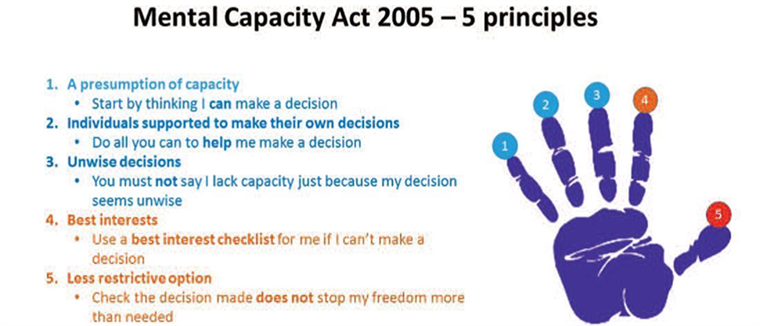
5.5 Practitioners must assess both an adult’s decisional and executive capacity. Executive capacity describes where an adult may appear able to weigh information whilst discussing the situation but if they do not apply their reported knowledge and understanding to real life situations, they may lack mental capacity.
5.6 Efforts should be made to build and maintain supportive relationships with the adult through which acceptable levels of support can be negotiated.
5.7 As noted within the West Midlands Adult Self-Neglect Best Practice Guidance, where an adult has been assessed as lacking the mental capacity to make specific decisions about their health and welfare, the Mental Capacity Act allows for intervention in the adult’s best interests. In some high-risk situations, where there is a view that an adult lacks mental capacity and urgent intervention is required, it may be necessary to make an application to the Court of Protection.
5.8 Where a person with capacity is at risk of serious harm or death and refuses all offers of support or interventions (or is unduly influenced by someone else), an application to the High Court should be considered for them to exercise their powers under Inherent Jurisdiction. Please refer to the following guidance on Inherent Jurisdiction
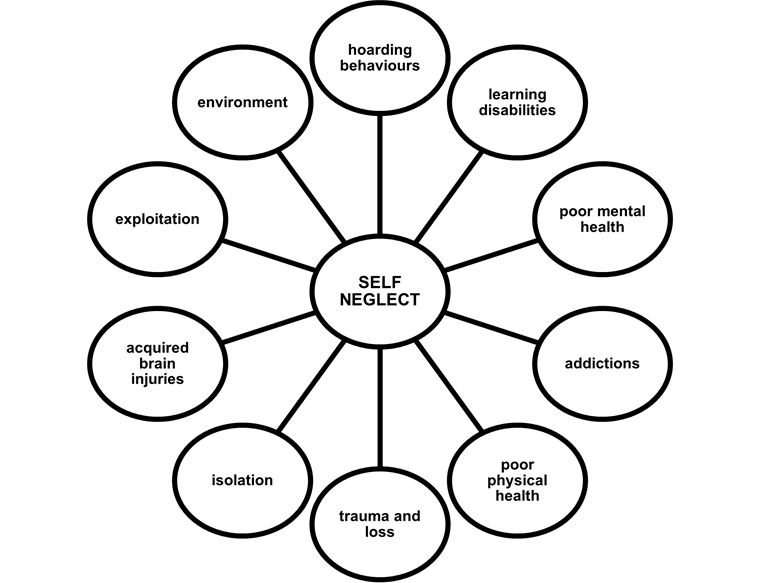
5.9 The diagram below identifies key factors that may be present in concerns relating to self-neglect.
Referral Points
5.10 Concerns relating to self-neglect will be made to the respective Contact Centres for Staffordshire County Council and Stoke-on-Trent City Council in accordance with the guidance detailed in Section 2.23 of these procedures.
5.11 When there are new concerns about self-neglect, the local area team will be required to complete an assessment of the adult’s care and support needs (if this has not already taken place).
Decision-making
5.12 As noted in Section 3, the Care and Support Statutory Guidance to the Care Act 2014 makes it clear that self-neglect is not necessarily to be considered as a cause for enquiry under Section 42. As such, when concerns relate to self-neglect the enquiry process will differ from the process described in Section 4 (see below).
5.13 If an assessment has been offered and either the assessment or the proposed care provision has been declined and it is considered that the adult remains at risk of harm, then the concerns may be considered under safeguarding processes.
5.14 Decision-making as to whether actions are needed under Section 42 of the Care Act will be based on the considerations described in Section 3.2, namely:
- The concern relates to a person who is 18 or over.
- The adult has needs for care and support (whether or not these are being met at this time).
- The adult is experiencing, or at risk of abuse, neglect, or self-neglect.
- As a result of the adult’s care and support needs the adult is unable to protect themselves from the risk of abuse or the experience of abuse or neglect.
5.15 Information gathering will take place to identify which of the relevant agencies know the adult or could have information to share as part of the decision-making process.
5.16 If it is felt that further actions under Section 42 of the Care Act 2014 are required, the concern will be progressed by the relevant area team irrespective of the level of risk.
Enquiry process
Multi-Agency Planning Meeting
5.17 The area team will arrange for a Multi-Agency Planning Meeting (MAPM) to take place within 10 days of the concern being raised (subject to the seriousness of the risk of future harm).
5.18 The MAPM will include all relevant agencies and should follow the agenda at the end of this section.
5.19 The MAPM will enable the sharing of information and will include consideration of the options for intervention and also the legal position.
5.20 The enquiry process for self-neglect concerns differs slightly in Staffordshire and Stoke-on-Trent. These are outlined below:
5.21 Staffordshire - The MAPM will be chaired by a Managing Officer from the area team for low and medium risk concerns. A Managing Officer from the Adult Safeguarding Enquiry Team will chair the MAPM for high-risk concerns.
5.22 No enquiry report will be required for this meeting. Where interventions are required this will be recorded as a safeguarding plan.
5.23 The minutes of the MAPM, the safeguarding plan and the minutes of any subsequent Safeguarding Plan Review Meetings will constitute the evidence of the enquiry process.
5.24 Stoke-on-Trent – The MAPM will be chaired by the Safeguarding Officer or a Managing Officer, dependent on the level of risk and complexity of the situation.
5.25 The Safeguarding Officer is required to complete a safeguarding enquiry report. Where interventions are required this will be recorded as a safeguarding plan.
5.26 This, along with the minutes of the MAPM, the safeguarding plan and the minutes of any subsequent Safeguarding Plan Review Meetings will constitute the evidence of the enquiry process.
5.27 Please refer to Section 4, 4.41 (Resolving Disagreements) if there are any areas of disagreement that need to be resolved.
Safeguarding Plan
5.28 A safeguarding plan is the document that clarifies all the protective or supportive systems that are in place, irrespective of who provides these and sets them out as steps towards a defined outcome.
5.29 The safeguarding plan will clearly identify what the objectives and safety goals are, who will be responsible for each aspect, who will co-ordinate the plan, communication arrangements and when it will be reviewed.
5.30 Safeguarding Plan Review Meetings should take place in all cases where there have been agreed safeguarding actions to ensure that there is multi-agency accountability and that safeguarding measures are adequate. The Safeguarding Plan Review Meeting should review the level of risk and identify any further actions needed.
5.31 The need to engage with the adult and to work in a person-centred and outcome-based manner is as important in cases of self-neglect as it is in cases of other types of abuse. In many cases the adult will have mental capacity to consent to interventions and support measures and therefore their participation and agreement will be of utmost importance.
5.32 Please refer to Section 6 for more information regarding safeguarding plans.
Self-neglect and advocacy
5.33 The ability of the adult to understand and participate in the safeguarding process must be considered all stages of the enquiry process.
5.34 Please refer to Paragraphs 4.73 - 4.79 on Independent Advocacy and “Substantial Difficulty“ in Section 4 of these procedures.
Legal Interventions
5.35 There are a range of legal interventions that can be considered by individual organisations in relation to concerns of self-neglect.
5.36 Please refer to Section 6 of the West Midlands Self-Neglect procedures for further details of the potential interventions available to different agencies.
5.37 The MAPM and any subsequent safeguarding plans and meetings should consider the use of legal interventions by any responsible agencies.
Self-neglect and deceased adults
5.38 Where an adult has died and it is known or suspected that the death resulted from self-neglect, consideration should be given as to whether a Safeguarding Adult Review under Section 44 of the Care Act 2014 needs to be completed by the Safeguarding Adults Board.
5.39 The Safeguarding Adult Review process will only be applicable where:
- there is reasonable cause for concern about how the SSASPB or a member of it or any other person involved in the adult’s care worked together to effectively protect the adult.
- there are clearly identified areas of learning and practice improvement or service development that have the potential to significantly improve the way in which adults are safeguarded in the future.
5.40 Please refer to the Staffordshire and Stoke-on-Trent Adult Safeguarding Partnership Board Website for more guidance on Safeguarding Adult Reviews Safeguarding Adult Reviews
Appendix 5.1 Self NeglectAgenda - Multi-Agency Planning Meeting (MAPM)
Download Appendicies
1. Introduction and apologies.
2. Confidentiality statement.
- Any information disclosed as a part of these discussions should not be shared with any other persons unless agreed as a specific action.
3. Purpose of the meeting:
- To review the self-neglect concerns.
- To clarify the desired outcomes of the adult and/or their advocate.
- To consider the level of risk to the adult.
- To identify immediate safeguarding arrangements and plan further actions.
4. Outline of concerns.
5. Views of the adult.
6. Views of relatives, carers and/or advocates.
7. Information sharing from each agency.
8. Discussion regarding mental capacity (to include the functional capacity to make a particular decision and the executive capacity which is the ability to carry out the decision).
9. Risk of harm assessment and rationale.
10. Legal Considerations.
11. Action Planning:
- Safeguarding Plan (Yes/No – minutes to include rationale for either decision and details of who will be responsible for completing the safeguarding plan).
- Advocacy (Yes/No – minutes to include rationale for either decision and details of who will be responsible for referring to advocacy services).
- Communication (to detail how information regarding this process will be communicated to the adult and/or their advocate and other interested parties).
12. Summary of agreed actions.
13. Further meetings required (include timeframe for subsequent
meetings or rationale if no further meetings required).