This section provides guidance on when and how to raise a safeguarding concern.
The section includes guidance on the following:
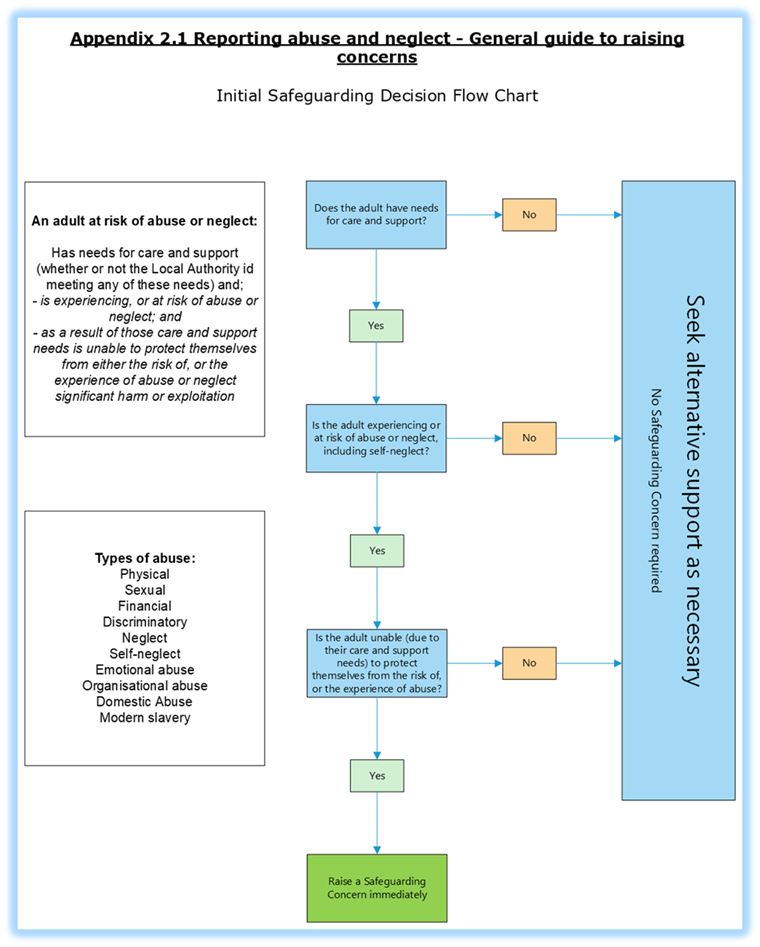
2.1 A safeguarding concern may be raised by anyone, including adults and informal carers when they believe that an adult:
- Has needs for care and support (whether or not the Local Authority is meeting any of those needs)
- is experiencing, or at risk of abuse or neglect;
- and as a result of those care and support needs is unable to protect themselves from either the risk of, or the experience of abuse and neglect.
2.2 The Care Act 2014 defines ten categories of abuse:
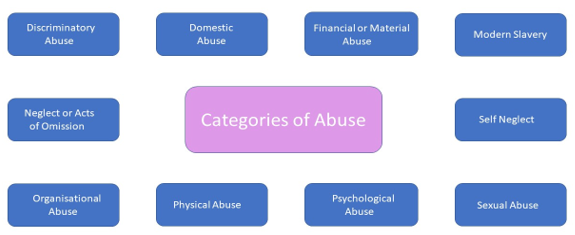
Examples and potential indicators of each type of abuse can be found within Chapter 14 of the Care Act Statutory Guidance. Further guidance is also available on the Staffordshire and Stoke-on-Trent Adult Safeguarding Board website
2.3 Self-neglect is seen as a classification of ‘abuse’ and therefore should be referred in the same way as abuse by others. Where there is concern that an adult is not meeting their own care needs the first action should be to ensure a care needs assessment has been undertaken. Self-neglect should not be taken to include a general refusal to consent to a specific form of care or treatment or behaviour arising from personal or cultural choices other than when this is connected with a serious risk of harm arising from a refusal of assessments and services. Please refer to Section 5 of these procedures and the West Midlands Adult Self-Neglect Best Practice regional guidance for further information.
2.4 Deliberate self-harm is not considered to be a form of self-neglect and would not, in isolation from other factors relating to abuse, be grounds for raising a safeguarding concern.
2.5 Safeguarding concerns and processes should not be used as a substitute for:
- Providers’ responsibilities to provide safe and high-quality care and support.
- Commissioners regularly assuring themselves of the safety and effectiveness of commissioned services.
- The Care Quality Commission (CQC) ensuring that regulated providers comply with the fundamental standards of care or by taking enforcement action.
- The core duties of the police to prevent crime and protect life and property.
2.6 Safeguarding concerns should not be raised as a means of escalating or resolving professional disagreements or interpersonal issues unless a risk to the adult is clearly indicated.
2.7 There is no requirement for care providers to raise a safeguarding concern in relation to single instances of poor practice where no lasting harm or distress has occurred and where there is a plan for protecting the adult from the risk of harm. If, however, the concerns form part of a pattern or culture within the service, a safeguarding concern should be raised. There is guidance available for care providers on the MIDOS platform for commonly reported concern.
2.8 If there is doubt as to whether a concern should be raised, then this should be clarified with the relevant Local Authority. Advice can also be obtained from your own organisations Safeguarding Lead/Team.
2.9 There is an expectation that providers will undertake their own internal investigations and take the appropriate disciplinary or remedial actions, as well as reporting significant incidents to the relevant regulators in line with regulations and legislation.
2.10 Care providers should clearly record their rationale as to why they did or did not raise a concern. Where applicable, this should include reference to the adult’s capacity.
2.11 Refer to Appendix 2.1 Reporting abuse and neglect – General guide to raising concerns.
Acting to Protect the Adult and Other People – Meeting Immediate Needs
2.12 Make an evaluation of the risk and take steps to ensure the adult is in no immediate danger. If there is a medical emergency, risk to life or risk of imminent injury, or if a crime is in progress, call 999.
2.13 If there is a concern about the adult’s health needs, seek medical assistance or advice from the GP or other primary healthcare service. You can call the NHS 111 service for medical help or advice when it is not a life-threatening situation.
2.14 Consider if there are other adults with care and support needs, or if there are any children (including unborn children) who are at risk of harm and take appropriate steps to safeguard them. The contact numbers for reporting adult safeguarding concerns are detailed in 2.22. To report concerns about a child please call:
Staffordshire County Council – Tel 0300 111 8007 and select option 1
Stoke-on-Trent City Council – Tel 01782 235100
2.15 Support and encourage the adult to consider contacting the police if a crime has been or may have been committed. The adult must be made aware that any professional has a duty to report a crime in the interests of their safety, even if the adult does not wish this to occur.
2.16 Secure any physical evidence such as clothing, bed linen etc. that may exist (this is especially relevant to sexual assaults). Items should be individually stored to avoid cross contamination.
Good Practice Guide – Preserving Physical Evidence
What to do?
In cases where there may be physical evidence of crimes (e.g. physical or sexual assault), contact the Police immediately. Ask their advice about what to do to preserve evidence.
As a guide-
- Where possible leave things as and where they are. If anything has to be handled, keep this to an absolute minimum.
- Do not clean up. Do not touch anything you do not have to. Do not throw anything away which could be evidence. Do not wash anything or in any way remove fibres, blood etc.
- Preserve the clothing and footwear of the victim.
- Preserve anything used to comfort or warm the victim, e.g. a blanket.
- Note in writing the state of the clothing of both the victim and person alleged to have caused the harm. Note injuries in writing. As soon as possible, make full written notes on the conditions and attitudes of the people involved in the incident.
- Take steps to secure the room or area where the incident took place. Do not allow anyone to enter until the Police arrive.
In addition, in cases of sexual assault –
- Preserve bedding and clothing where appropriate, do not wash.
- Try not to have any personal or physical contact with either the victim or the person alleged to have caused the harm. Offer reassurance and comfort as needed but be aware that anyone touching the victim or source of risk can cross contaminate evidence.
West Midlands Adult Safeguarding Policy and Procedures
Reporting Adult Safeguarding Concerns
2.17 A safeguarding concern can be identified and reported by anyone, including the adult, a carer, family or friends, professionals, or members of the public.
2.18 The primary responsibility of anyone who becomes aware of any abuse is to seek to make the situation as safe as possible for the adult and to take steps to prevent any further abuse.
2.19 It is always important that staff apply professional judgement in deciding whether a referral should be made. By raising a concern staff are stating that they believe that the adult is experiencing, or at risk of, abuse or neglect.
2.21 People raising a concern may become aware of possible abuse when they:
a. Witness an abusive act.
b. Are told about abuse by someone else.
c. Are told about abuse by the adult.
d. Find evidence of abuse
e. Recognise several of the risk indicators and become concerned that there is a high risk of abuse.
2.22 Adult safeguarding concerns should be reported to the relevant local authority without delay and always within 24 hours.
2.23 Refer any safeguarding concern that it is believed meets the criteria at Section 2.1 to the Local Authority for the area where the abuse took place by telephoning the relevant Contact Centre.
If the abuse occurred in Stoke-on-Trent – Tel: 0800 561 0015 (available during standard office hours)
If you have a concern about the safety of an adult with care and support needs in Stoke-on-Trent and need to report these concerns overnight, over a weekend or on a Bank Holiday, please contact the Emergency Duty Service on Tel: 01782 238770
If the abuse occurred in Staffordshire – Tel: 0345 604 2719 (available during standard office hours)
If you have a concern about the safety of an adult with care and support needs in Staffordshire and need to report these concerns overnight, over a weekend or on a Bank Holiday, please contact the Emergency Duty Service on Tel: 0345 604 2886
2.24 If a crime is in progress or life is at risk, dial 999.
2.25 If a criminal offence has occurred, or may occur, contact the Police force where the crime has occurred/may occur via 101 or online reporting mechanisms.
2.26 Consider if there are other adults with care and support needs, or if there are any children (including unborn children) who are at risk of harm and take appropriate steps to safeguard them.
2.27 If you are an employee, inform your manager. Report the matter internally in accordance with your own organisations reporting procedures.
2.28 If your service is registered with the Care Quality Commission (CQC), and the incident constitutes a notifiable event, complete and send a notification to CQC.
Reporting to Internal Management
For People who work or volunteer within organisations
2.29 If you are concerned that a member of staff in your organisation has abused or neglected an adult with care and support needs, you have a duty to report these concerns. Refer to your own organisations policy on escalating concerns.
2.30 If you are concerned that your line manager has abused or neglected an adult with care and support needs, you must inform a senior manager, or another Adult Safeguarding Lead, in your organisation. If you do not feel safe or comfortable reporting the matter within your own organisation, or if you have already raised concerns with your managers but no action has been taken, you can report the concern to the Local Authority in your area.
Taking Management Action in Response to Concerns
2.31 The line manager or the Adult Safeguarding Lead within the organisation to which the concern relates should then decide on the most appropriate course of action without delay.
This should include:
- Check and review actions already taken, and decisions made.
- If not already done so:
- Make an evaluation of the risk to the adult.
- Wherever it is safe or appropriate to do so, speak to (or decide who is the best placed person to speak to) the adult to gain their views about the concern and what they would like to happen next.
- Take reasonable and practical steps to safeguard the adult.
- Consider referring to the police if the suspected abuse appears to be a crime.
- If the matter is to be referred to the police, discuss risk management and any potential forensic considerations with the police.
- Arrange any necessary emergency medical treatment. Note that offences of a sexual nature will require expert advice from the police.
- Make sure that other people are not at risk.
- If the person alleged to have caused the harm is also an adult with care and support needs, arrange for a member of staff to attend to their needs.
- Take action in line with the organisation’s disciplinary procedures, as appropriate, if a member of staff is alleged to have caused harm. Inform your Adult Safeguarding Lead.
- Ensure that records are made of any concerns, and that decisions are clearly recorded with the rationale.
- Raise a safeguarding concern if necessary.
2.32 Organisations should ensure that they have procedures in place to provide appropriate line manager cover to respond to such concerns, despite leave or where services operate extended or 24-hour cover.
2.33 National Health Service (NHS) staff will need to refer to their trust’s procedures on clinical governance and adult safeguarding, in conjunction with the Staffordshire and Stoke-on-Trent Adult Safeguarding Enquiry Procedures. In line with these procedures NHS staff will raise appropriate safeguarding concerns to the Local Authority for the area where any alleged abuse occurs.
Whistle-blowing and Confidentiality for People Raising a Concern
2.34 All agencies should have a clear policy on whistleblowing, which highlights how employees can raise concerns about abusive or neglectful acts of colleagues or employing organisations if they feel unable to raise these through their line management. Whistleblowing policies should be consistent with the legal requirements of the Public Interest Disclosure Act 1998.
2.35 In most cases staff will raise concerns without recourse to whistleblowing procedures and it is important that the use of whistleblowing is not used as a means of seeking anonymity where there would be no genuine fear of repercussions. While every effort will be made to protect the identity of workers who are raising concerns, anonymity cannot be guaranteed throughout the process.
2.36 It is important to remember:
In cases where the police are pursuing a criminal prosecution, workers or other witnesses may be required to give evidence in Court.
- Information from any safeguarding enquiry under Section 42 of the Care Act 2014 and disciplinary investigation could be shared with the person identified as the source of risk if a referral to the Disclosure and Barring Scheme (DBS) is made.
- There is a possibility that a worker maybe asked to give evidence at an employment tribunal.
- Anyone can be requested to give evidence when the employer has referred a member of staff to a professional body (e.g. Social Work England (SWE), Nursing and Midwifery Council (NMC), Health and Care Professions Council (HCPC), General Medical Council (GMC).
- The adult or the potential source of risk may request to see information held about them under the General Data Protection Regulations 2016.
Members of the Public who wish to raise anonymous concerns
2.37 It is preferable to know who is raising a concern; however, a member of the public does not have to give their personal details. If the identity of the person raising the concern has been withheld, the process will proceed in the usual way. This will include information being recorded onto the safeguarding contact.
Speaking to the Adult who is experiencing, or is at risk of experiencing, abuse or neglect before raising the concern
2.38 From the very first stages of concerns being identified, the views of the adult should be gained. This will enable the adult to give their perspective about the potential abuse or neglect concerns that have been raised, and what outcomes they would like to achieve. These views should directly inform what happens next.
2.39 There will be situations where speaking to the adult could put them at further or increased risk of harm. Examples include:
- Retaliation
- The risk of fleeing or removal of the adult from the local area,
- An increase in threatening or controlling behaviour if the person causing the risk of harm were to know that the adult had told someone about the abuse or neglect, or that someone else was aware of it.
2.40 The safety of the adult and the potential for increasing the risk should always be considered when planning to speak to the adult. Any situations where there is the potential for endangering safety or increasing risk should be assessed carefully and advice taken from management or from an external agency as appropriate.
2.41 When speaking to the adult –
- Speak to the adult in a private and safe place and inform them of the concerns. The person alleged to be the source of the risk should not be present in all but the most exceptional of circumstances and the reasons should be recorded.
- Get the adult’s views on the concern and their desired outcomes; Consider the following section on Mental Capacity and Consent.
- Give the adult information about the safeguarding process.
- Explain confidentiality issues, how they will be kept informed and how they will be supported.
- Consider care and support needs, including mental capacity, communication including the use of any aids or requirement for independent interpreter services.
- Identify whether the adult requires support (either informal of formal advocacy) to understand and participate in the enquiry process.
- Discuss what could be done to make them safer, including any immediate safeguarding measures needed.
Recording at Point of Referral
2.42 Make a written record of the incident as soon as possible. Try to make sure anyone else who saw or heard anything relating to the concern also makes a written record.
What to include in a written record of the incident:
- The date and time when the disclosure was made, or when you were told about/ witnessed the incident(s)
- Who was involved, any other witnesses including other adults with care and support needs and/or staff?
- Exactly what happened or what you were told, in the adult’s own words, keeping it factual and not interpreting what you saw or were told?
- The views and wishes of the adult.
- The presentation and behaviour of the adult and/or the person making the disclosure.
- Any injuries observed.
- Any actions and decisions taken at this point.
- Any other relevant information, e.g. previous incidents that have caused you concern.
Remember to:
- Include as much detail as possible.
- Make sure the written record is legible, written or printed in black ink, and is of a quality that can be photocopied or scanned.
- Make sure you have printed your name on the record and that it is signed and dated.
- Keep the record factual as far as possible. However, if it contains your opinion or an assessment, it should be clearly stated as such and be backed up by factual evidence. Information from another person should be clearly attributed to them.
- Keep the record/s confidential, storing them in a safe and secure place until needed.
A printable version of the above checklist is included in Appendix 2.
Mental Capacity and Consent
2.43 Anyone who acts for, or on behalf of, a person who may lack capacity to make relevant decisions has a duty to understand and work in compliance with the Mental Capacity Act 2005(MCA) and the associated Code of Practice. Any decision that the adult may not fully understand or is unable to make will require an assessment of the adult’s mental capacity and, where the adult does not have capacity to make the decision, others will need to make a decision that is in the adult’s best interests.
2.44 At the concern stage, the most common capacity & consent issues to consider will usually be:
- Whether the adult has the mental capacity to understand & make decisions about the abuse or neglect related risks, & any immediate safety actions necessary.
- Whether the adult consents to immediate safety actions being taken.
- Whether the adult consents to information being referred / shared with other agencies.
2.45 Even if it is felt that the adult may not have the mental capacity to understand the relevant issues and to make a decision, efforts should still be made to explain the concerns and process taking into account the adults care and support needs. The adult should be given the opportunity to express their wishes and feelings.
2.46 It is important to establish whether the adult has the mental capacity to make specific decisions. This may require the assistance of other professionals. In the event of the adult not having capacity, relevant decisions and/or actions must be taken in the person’s best interests. The identity of the appropriate decision-maker will depend on the decision to be made and should be clearly recorded.
Reporting without Consent
2.47 All adults have the right to choose and control in their own lives. As a general principle, no action should be taken for, or on behalf of, an adult without obtaining their consent. However, there will be times when it is necessary to override the adults wishes and raise the concern without their consent.
2.48 If there is an overriding public interest or vital interest, or if gaining consent would put the adult at further risk, the concern must be reported.
2.49 Other circumstances in which someone could reasonably raise a concern without the adult’s consent include:
- The adult lacks the mental capacity to make that decision – this must be properly explored and recorded in line with the Mental Capacity Act.
- Other people are, or may be, at risk including children.
- Sharing the information could prevent a crime.
- A serious crime has been committed.
- The alleged source of risk has care and support needs and may also be at risk:
- Staff are implicated:
- The adult has the mental capacity to make that decision, but there are concerns they are under duress or being coerced.
- The risk is unreasonably high and meets the criteria for a multi-agency risk assessment conference.
- A court order or other legal authority has requested the information.
2.50 The adult should be informed of the decision to report and the reasons for this, unless telling them would jeopardise their safety or the safety of others.
2.51 If the person cannot be persuaded to give their consent then, unless it is considered dangerous to do so, it should be explained to them that the information will be shared without consent. The reasons should be given and recorded. The safeguarding principle of proportionality should underpin decisions about sharing information without consent, and decisions should be on a case by case basis (Safeguarding adults: sharing information - SCIE).
2.52 Disclosure without consent needs to be justifiable and the reasons recorded by professionals in each case.
2.53 If any person is unsure whether to report, they should contact the relevant Local Authority for advice.
2.54 If it is necessary to share information outside the organisation:
- Explore the reasons for the adult’s objections – what are they worried about?
- Explain the concern and why you think it is important to share the information,
- Tell the person who you would like to share information with and why,
- Explain the benefits, to them or others, of sharing information – could someone come to harm?
- Reassure them that the information will not be shared with anyone who does not need to know,
- Reassure them that they are not alone, and that support is available to them.
2.55 If none of the points in 2.50 apply and the decision is not to share the safeguarding information with other safeguarding partners, or not to intervene to safeguard the person:
- Support the adult to weigh up the risks and benefits of different options.
- Ensure they are aware of the level of risk and possible outcomes.
- Offer to arrange for them to have an advocate or peer supporter.
- Offer support for them to build confidence and self-esteem if necessary.
- Agree on and record the level of risk the adult is taking.
- Record the reasons for not intervening or sharing information.
- Regularly review the situation.
- Try to build trust and use gentle persuasion to enable to person to better protect themselves.
Remember
There are only a limited number of circumstances where it would be acceptable not to share information and report adult safeguarding concerns.
These would be where the person involved has the mental capacity to make the decision and does not want their information shared and;
- Nobody else is at risk.
- No serious crime has been or may be committed.
- The alleged abuser has no care and support needs.
- No staff are implicated.
- No coercion or duress is suspected.
- The public interest served by disclosure does not outweigh the public interest served by protecting confidentiality.
- The risk if not high enough to warrant a multi-agency risk assessment conference (MARAC) in domestic abuse situations.
- No other legal authority has requested the information.
In such situations, you should discuss this with your manager or the Safeguarding Lead in your organisation, and you may need to take legal advice. The reasons for not intervening or sharing information must always be clearly recorded.
West Midlands Adult Safeguarding Policy and Procedures
Providing Support Pending Progression of a Safeguarding Concern
2.56 In any situation where medical assistance is required then this must be provided as a priority.
2.57 Providers will ensure that the adult is protected from any known source of risk as much as possible in accordance with the adults wishes. If the adult lacks capacity, any actions should be taken in their best interests.
2.58 All necessary planned care should be provided as usual unless there has been specific advice from the police that this should not occur. Consider the need to preserve any physical evidence.
2.59 Appropriate emotional support should be provided, and the adult should be reassured as far as possible that they will be assisted and supported.
2.60 It should be considered whether the adult needs an assessment of their care and support needs. Where an adult declines a needs assessment, the Local Authority concerned is not required to carry out the assessment. However, it should be emphasised that Section 11 of the Care Act states that the Local Authority must carry out a needs assessment where:
- The adult lacks capacity and the authority is satisfied that carrying out the assessment would be in the adult’s best interest, or
- The adult is experiencing, or is at risk, abuse
2.61 If the provider is unsure as to whether a course of action is appropriate, then seek advice from internal management or from the Local Authority Safeguarding Team.
2.62 Any necessary disciplinary action can be instigated. Providers should be aware of the need to consult the Police about interviewing staff where there is a criminal investigation taking place.
2.63 Care providers must update the Local Authority Safeguarding Team of any significant changes or new information (e.g. hospital admission of adult or death).
People Causing Harm who are Employed in Positions of Trust (PIPOT)
2.64 Where allegations relate to paid staff or others in positions of trust proportionate action should be taken to ensure the immediate protection of the adult(s) with care and support needs. Further guidance can be found in the West Midlands Person in a Position of Trust (PiPoT) guidance and Section 9 of these procedures.
2.65 Where the concerns require police involvement wherever possible liaise with the police prior to communicating with the person who works in a position of trust.
2.66 If the person is a member of staff, advice should be sought from the Human Resources department. An immediate decision may have to be made to take action to protect the adult and/or others against any potential risk of harm (e.g. suspension without prejudice, supervised working etc.). Actions taken will need to be compliant with employment law and the employee will have a right to know in broad terms that allegations or concerns have been raised about them.
2.67 Although any agency may have an opinion regarding the suitability of a person to work in a Position of Trust, the responsibility for decisions regarding suspension, dismissal and other levels of disciplinary action lie with the employer alone. Commissioners and regulators may take a view about the compliance of a service if they believe that a person in a position of trust poses a risk to adults with care and support needs. However, this cannot override the employer’s legal responsibilities to act fairly and proportionately in handling a disciplinary matter.
Prisoners and Adults in Approved Premises
2.68 Most Care Act duties apply to adults who are prisoners or who live in approved premises. For example, Local Authorities have a duty to undertake an assessment of needs under Section 9 of the Care Act for adults who are in prison or living in approved premises. However, the duty of enquiry under Section 42 of the Care Act does not apply to adults in prison or approved premises. Instead, responsibility lies with HM Prison Service and the Probation Service.
2.69 If you are a relative or friend and are worried or concerned about someone in prison please visit the Prisoners’ Families helpline website
Appendices
Section 2 Appendix 1 General Guide to Raising Concerns
Section 2 Appendix 2 What to include in a written record of the concern
Appendix 2.2 Reporting Abuse and Neglect – What to include in a written record of the incident.
Make a written record of the incident as soon as possible.
Try to make sure anyone else who saw or heard anything related to the concern also makes a written record.
Use the checklist below as a prompt: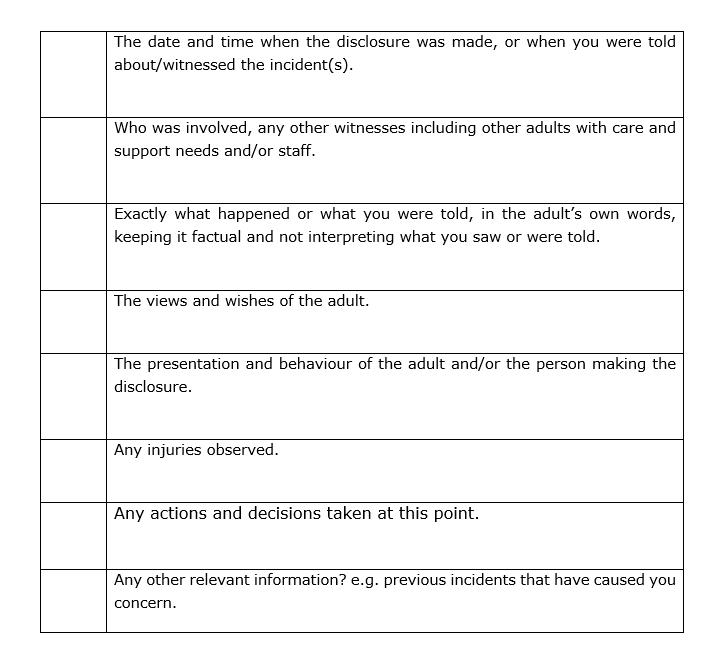
Appendix 2.3 Reporting Abuse and Neglect – How and When to Raise a Safeguarding Concern
| Who can raise a safeguarding concern? |
Anyone. |
| Who decides whether to raise a concern? |
The person who believes that abuse may be taking place is the best person to raise the concern and they should take the responsibility for doing so. It is not good practice for that person to delegate this to another agency and this will cause difficulties if that agency has a different view on the incident. |
| How quickly should a concern be raised? |
As soon as possible, but always within 24 hours. |
| How should a concern be raised? |
In all cases, concerns will be raised with the Local Authority where the abuse is believed to have taken place: Staffordshire County Council, Tel: 0345 604 2719 or if out of hours 0345 604 2886 Stoke-on-Trent City Council, Tel: 0800 5610015 (available 24 hours a day, 7 days a week) Where a crime has taken place, or the adult may be in immediate danger contact should be made with Staffordshire Police. In emergencies use 999 or if less urgent use 101 or online reporting mechanisms. |
| What information to include when raising a concern? |
Personal details of the adult (name, date of birth, address, gender, race, faith, culture and current whereabouts). Name, address, contact number of the person raising the concern, and their relationship to the adult. Full description of the abuse that is believed to have taken place including where and when it occurred. All known details of the potential source of risk (name, address, date of birth, gender, current whereabouts and relationship to the adult). Details of any harm caused to the adult. Perception of continuing risks. Immediate action taken or required to protect the adult. Details of other people who may be at risk of harm, including children. Details of any action already taken (e.g. call to emergency services, crime number, and protection measures.) Details of agencies involved with the adult. Whether the adult is aware of the concern being raised. Whether the adult has consented to the concern being raised. If the adult has not consented, the referrer should detail why the concern is being reported without consent. Any known views or wishes of the adult regarding possible outcomes. The views of the person raising the concern about what needs to happen next. Any information that relates to the mental capacity of the adult in relation to their ability to protect themselves from harm. Any known language or communication needs (e.g. need for an interpreter or intermediary). |
| What if the adult does not wish for the concern to be raised?? |
If an adult refuses intervention to support them with a safeguarding concern, or requests that information about them is not shared with safeguarding partners, their wishes should be respected. However, if there is an overriding public interest or vital interest, or if gaining consent would put the adult at further risk, the concern must be reported. Circumstances where safeguarding concerns should be raised even if the adult does not consent, include: The adult lacks capacity to make the decision. The adult has capacity to make the decision but may be under duress or experiencing coercion. Other people are, or may be, at risk (including children). A crime has been committed or sharing the information could prevent a crime. The alleged source of risk has care and support needs and may also require intervention. Paid or Voluntary members of staff are implicated. The safeguarding principle of proportionality should underpin any decisions about sharing information without consent. The reasons for reporting without consent should be explained to the adult (if appropriate) and their views recorded. |
| What feedback will be given on concerns that have been raised? |
People raising a concern should be given information regarding the status of the concern they have raised. The extent of this feedback will depend on various things (e.g. the relationship they have with the adult, confidentiality issues and the risk of compromising an investigation). It should be possible at a minimum to advise the referrer that the local authority has satisfied its duties under Section 42 the Care Act 2014. |
Appendix 2.4 Reporting Abuse and Neglect – Responding to Disclosures
Good Practice Guide – Responding to Disclosures
It is often difficult to believe that abuse or neglect can occur. Remember, it may have taken a great amount of courage for the person to tell you that something has happened and fear of not being believed can cause people not to tell.
- Accept what the person is saying – do not question the person or get them to justify what they are saying – reassure the person that you take what they have said seriously.
- Don’t ‘interview’ the person; just listen carefully and calmly to what they are saying. If the person wants to give you lots of information, let them. Try to remember what the person is saying in their own words so that you can record it later.
- You can ask questions to establish the basic facts but try to avoid asking the same questions more than once, or asking the person to repeat what they have said- this can make them feel they are not being believed.
- Don’t promise the person that you’ll keep what they tell you confidential or “secret”. Explain that you will need to tell another person, but you’ll only tell people who need to know so that they can help.
- Reassure the person that they will be involved in decisions about what will happen.
- Do not be judgemental or jump to conclusions. If the person has specific communication needs, provide support and information in a way that is most appropriate to them.
West Midlands Adult Safeguarding Policy and Procedures