This section provides guidance on People in positions of trust (PIPOT) regarding Section 42 enquiries (Care Act 2014).
This section outlines the process for responding to allegations and concerns against people working with adults with care and support needs. The section should be read in conjunction with the
West Midlands Adult Position of Trust Framework – A Framework and process for responding to allegations and concerns against people working with adults with care and support needs. A quick reference guide is provided at the end of this section.
9.1 It is a requirement of the Care Act 2014 Statutory Guidance that Safeguarding Adults Boards should establish and agree a framework and process for any organisation to respond to allegations against anyone who works (in either a paid or an unpaid capacity) with adults with care and support needs. In line with this local authorities, their relevant partners and those providing care and support services should have clear policies detailing how they will respond to allegations against people in a position of trust.
9.2 The Care Act does not set out any primary legal duties on the local authority regarding managing allegations against people who work in a position of trust with adults with care and support needs. Section 14 of the Statutory Guidance contains information relating to allegations against people in positions of trust. Other relevant legislation includes: Data Protection Act 2018/General Data Protection Regulations, Human Rights Act 1998 and employment legislation.
9.3 This section applies to safeguarding concerns and allegations about:
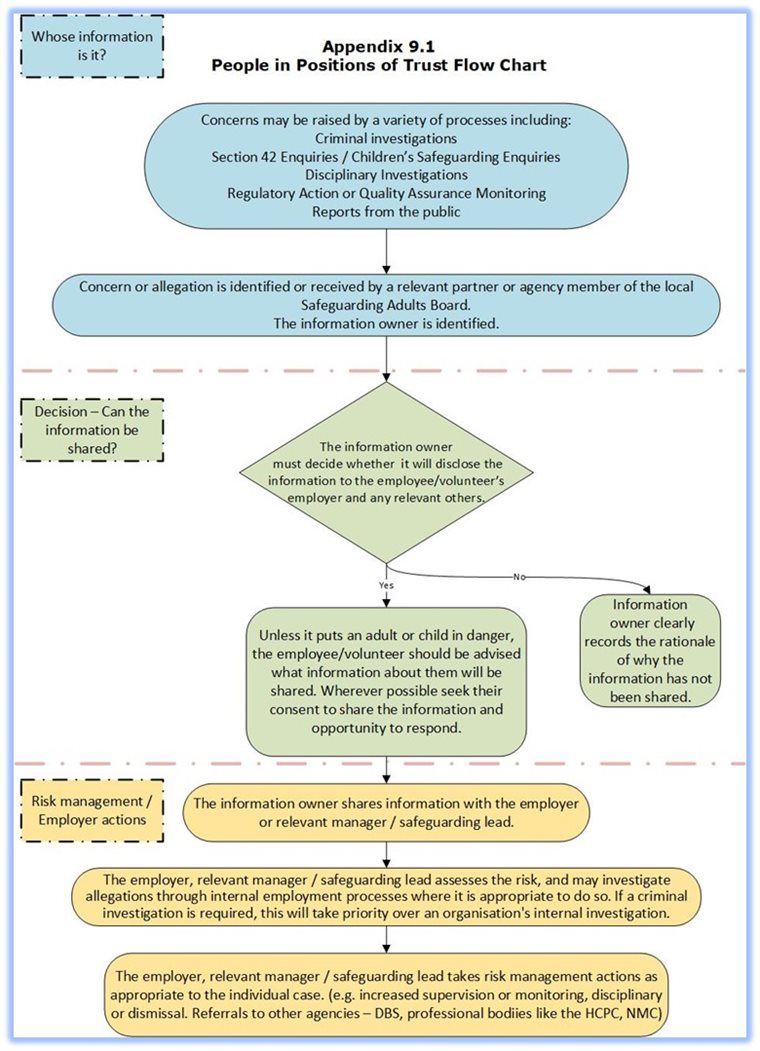
- A person who works with adults with care and support needs in a position of trust, whether an employee, volunteer or student (paid and unpaid)
- Where those concerns indicate the person in a position of trust poses a risk of harm to adults with care and support needs.
9.4 Examples of such concerns could include allegations that the person in a position of trust has:
- Behaved in a way that has harmed or may have harmed an adult or child.
- Possibly committed a criminal offence against, or related to, an adult or child
- Behaved towards an adult or child in a way that indicates they may pose a risk of harm to adults with care and support needs
- Their conduct, either inside or outside the workplace, may impact on their suitability to work with adults with care and support needs or children.
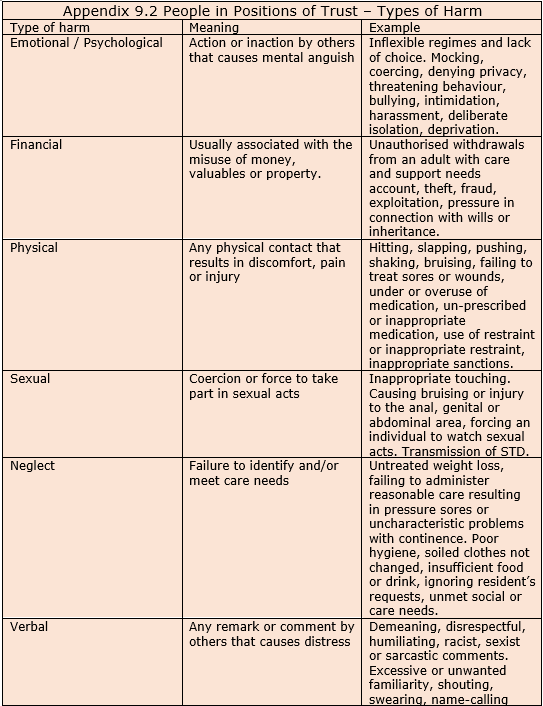
9.5 The table in Appendix 9.2 provides some examples of harm. This isn’t a definitive list but provides details about the different types of harm that may be identified.
9.6 Concerns may be raised through a variety of processes including:
- Criminal Investigations
- Section 42 Enquiries
- Children’s Safeguarding Enquiries
- Disciplinary Investigations
- Regulatory action or Quality Assurance monitoring
- Reports from the public
9.7 This framework and process applies whether the concern regarding the person in a position of trust is current or historical. Where the allegation or concern is historical, it is important to ascertain if the person is currently working with adults with care and support needs or children and if that is the case, to consider whether information should be shared with their current employer.
9.8 This section does not cover complaints or concerns raised about the quality of the care or professional practice provided by the person in a position of trust. These should be dealt with under the relevant agency or individual complaints or regulatory processes.
Responding to concerns about People in a Position of Trust
9.9 The primary responsibility of anyone who becomes aware of any abuse is to seek to make the situation as safe as possible for the adult and to take steps to prevent any further abuse.
9.10 Any actions necessary to address welfare concerns in relation to an adult involved should be taken without delay. Please refer to Section 2.11 -2.15 “Acting to Protect the Adult and Other People – Meeting Immediate Needs”.
9.11 As noted with Section 2 (2.29-2.30), if there are concerns that a member of staff (either paid or unpaid) in your organisation has abused or neglected an adult with care and support needs, you have a duty to report these concerns. Refer to your own organisations policy on escalating concerns.
9.12 It is expected that every organisation will have appropriate policies and procedures in place to manage allegations against their staff.
9.13 Policies and procedures should be clear and accessible, setting out their process for managing risk should they become aware of a concern about a member of their staff. These should determine who should undertake an investigation, including setting timescales and how support and advice will be made available to individuals against whom allegations have been made.
9.14 Any allegations against people in a position of trust should be reported immediately to a senior manager within the organisation. Employers should have their own source of advice (including legal advice) in place for dealing with such concerns.
9.15 In situations where informing a manager will involve delay in a high-risk situation you should report the concern to external agencies (for example, the Police or Local Authority) immediately.
9.16 If the concern indicates a criminal offence has occurred or may have occurred, this must be reported to the Police immediately.
9.17 If a criminal investigation is required, this will take priority over an organisation’s internal investigation.
9.18 Employers not only have a duty to the adult with care and support needs, but also a responsibility to take action in relation to the employee when allegations of abuse are made against them.
9.19 Employers should ensure that their disciplinary procedures are compatible with the responsibility to protect adults at risk of abuse or neglect.
9.20 When a person’s conduct, either inside or outside the workplace, may impact on their suitability to work with or continue to work with adults with care and support needs or children this must be referred to the local authority safeguarding team/designated officer.
9.21 Any organisation completing an internal investigation should provide feedback at regular intervals to the relevant Local Authority (if there is a related safeguarding concern) and to their commissioning agency (if they have one).
Concerns relating to a person in a position of trust who works outside of the Staffordshire or Stoke-on-Trent area
9.22 If the concerns relate to a person in a position of trust working in a different local authority area, then agencies should review the relevant Local Authority/Safeguarding Adult Board guidance and make referrals as required.
Reporting to DBS or Regulatory bodies
9.23 Where appropriate, employers should report workers to the statutory and other bodies responsible for professional regulation such as the General Medical Council, Nursing and Midwifery Council or Social Work England
9.24 If a person is removed from their role providing regulated activity following a safeguarding incident, the regulated activity provider has a legal duty to refer to the Disclosure and Barring Service (if the person has been provided by an agency, the legal duty sits with them).
9.25 The legal duty to refer to the Disclosure and Barring Service also applies where a person leaves their role to avoid a disciplinary hearing following a safeguarding incident and the employer/volunteer organisation feels they would have dismissed the person based on the information they hold.
Standard of Proof
The Standard of proof for prosecution is “beyond reasonable doubt”. The standard for internal disciplinary procedures and for discretionary barring consideration by the Disclosure and Barring Service (DBS) and the Vetting and Barring board is usually the civil standard of “on the balance of probabilities”.This means that when criminal procedures are concluded without action being taken this does not automatically mean that regulatory or disciplinary procedures should cease or not be considered.In any event there is a legal duty to make a safeguarding referral to DBS if a person is dismissed or removed from their role due to harm to a child or a vulnerable adult.
REMEMBER - It is an offence not to make a referral without good reason.
9.26 For full details of when and how to refer an individual to the DBS and referral when the situation does not meet the legal duty please visit the DBS website
Information Sharing
9.27 Decisions on sharing information must be justifiable and proportionate, based on the potential or actual harm to adults or children at risk, and the rationale for decision-making should always be recorded.
9.28 Information should only be shared between agencies:
- where relevant and necessary, not simply all the information held
- with the relevant people who need all or some of the information
- when there is a specific need for the information to be shared at that time
9.29 The General Data Protection Regulation (GDPR) and the Data Protection Act 2018 introduce new elements to the data protection regime, superseding the Data Protection Act 1998.
9.30 Information relevant to adult safeguarding will often be data that the Act categorises as “special category personal data”, meaning it is sensitive and personal. Wherever possible, individuals and agencies should seek consent to share information, and be open and honest with the individual from the outset as to why, what, how and with whom, their informationwill be shared.
REMEMBER: If consent is not given or cannot be gained, the GDPR and Data Protection Act 2018 do not prevent, or limit, the sharing of information for the purposes of keeping adults with care and support needs safe.
Key roles and responsibilities
Information Owner
9.31 The owner of the information relating to the concern or allegation is expected to:
- Consider if the information indicates that any immediate risk management actions are needed, or referrals into adult or children safeguarding processes,
- Consider whether the allegation or concern indicates a criminal offence has occurred or may occur. If so, the allegation or concern must be reported to the Police.
- Refer to the relevant Local Authority Local Authority Designated Officer (LADO) where the information indicates the person also works with and could pose a risk of harm to children.
9.32 Local Authority Designated Officer Contact details:
Staffordshire – Tel: 0300 111 8007 or complete the online enquiry form Stoke-on-Trent – Tel: 01782 235100 or e-mail CHAD.Referrals@stoke.gov.uk
- Make a decision whether the information should be disclosed to the person in a position of trust’s employer.
- When making a decision, consider any known history of conduct, complaints, cautions or convictions that may be relevant to the potential risk.
- If disclosing, manage this disclosure in line with legal and best practice requirements for information sharing. Refer to Information sharing guidance in Section 3 (paragraphs 3.31 – 3.34).
- Where a disclosure is made, it should be clarified who will notify the relevant service commissioners and regulatory agencies.
- Record the information and decisions clearly, including the rationale for any decision made.
- Records should be maintained in line with internal agency record keeping policies and requirements.
- Agencies must be clear regarding the retention schedule of any records that are kept and must be prepared to remove or destroy any records for which there is no longer any reasonable need.
Employers, student bodies, or voluntary organisations
9.33 All organisations should have robust recruitment practices, with checkable references and the required level of DBS checks (Care Act Statutory guidance).
9.34 Once the employer, student body or voluntary organisation has been informed, they are responsible for assessing the risks in the context of their service or organisation. Only they have the authority to suspend, redeploy or make other changes to the working arrangements.
9.35 The employer, student body or voluntary organisation must:
- Share information in line with these procedures where it is known the person in a position of trust also has other employment or voluntary work with adults with care and support needs or children.
- Provide feedback at regular intervals to the relevant Local Authority (if there is a related safeguarding concern) and to their commissioning agency (if they have one)
- Ensure that appropriate action is taken by their organisation so that learning from current or past events is applied to reduce the risk of harm to adults with care and support needs in the future.
- Record the information and decisions clearly, including the rationale for any decision made.
- Records should be maintained in line with internal agency record keeping policies and requirements.
Local Authorities
9.36 Local Authorities are often in receipt of sensitive information regarding people in positions of trust.
9.37 Each Local Authority will have a lead manager who can be contacted by internal and external colleagues about issues posed by people in a Position of Trust.
Staffordshire County Council – craig.cassells@staffordshire.gov.uk
Stoke-on-Trent City Council – alisdair.heath@stoke.gov.uk
9.38 The Local Authority will consider information that is shared and will normally encourage the organisations that are the information owner/data controllers to make decisions regarding disclosure.
9.39 In a smaller number of cases the agencies may not be willing or able to decide on whether disclosure is appropriate, and, in this situation, the Local Authority may need to take a view on this.
9.40 There will be some circumstances where the information is not clearly in the possession of any data controller or where the information is provided by a private individual. In these cases, the Local Authority will consider whether disclosure is necessary.
9.41 In certain cases where the person has links to several organisations or where there is a believed to be a risk to adults in several settings it may be necessary for the Local Authority to convene a meeting to gather further information and/or consider the information that is held and to make decisions regarding disclosure and/or further action.
9.42 In any case where a person is believed to pose a risk to children the information should be shared with the Local Authority Designated Officer (LADO) for that Local Authority.
9.43 Ther Local Authority must record the information and decisions clearly, including the rationale for any decision made.
9.44 Local Authority records should be maintained in line with internal agency record keeping policies and requirements.
Service commissioners and regulators
9.45 Service commissioners and regulators are expected to:
- Use their contract compliance and regulatory processes to ensure that service providers have the right internal policy and procedural frameworks, and respond appropriately to manage risk in individual cases
- Monitor the activities of commissioned services in their compliance with these policies and procedures.
- Record the information and decisions clearly, including the rationale for any decision made.
- Records should be maintained in line with internal agency record keeping policies and requirements.
Case example 1 – A 39 year old woman is subject to longstanding domestic abuse risks from her partner. Childrens Services become involved due to potential impact on the couple’s children. As part of their assessment, they identify that the woman works as a care assistant in a care home for older people with dementia.
Childrens Services consider the adult position of trust issues and framework. Childrens Services are the information owner and think through whether they have a duty to make a disclosure to the woman’s employer. Childrens Services decide that disclosure is not proportionate in the situation – the woman is in a very difficult domestic situation, is engaging well with Childrens Services to take steps to protect her children, and there is no evidence that either she or the abuse in her relationship would pose a likely risk of harm to the adults in the care home where she works.
Childrens Services have a discussion with the woman and inform her that they will not be disclosing information to her employer but encourage her to tell her employer herself. The woman agrees to inform her employer about her home situation so that her employer can make a risk assessment and provide support for her in the work environment.
Replicated from the West Midlands Adult Position of Trust Framework
Case example 2 -A doctor employed in an NHS hospital is arrested by Police for historical child sex offences. The doctor works with a range of adults in their role, some of whom will have needs for care and support.
The Police are the information owner and decide they do need to disclose the information to the NHS Hospital Trust as the employer of the doctor. The Police inform the NHS Hospital Trust about the arrest for historical child sex offences and notify the Care Quality Commission as regulator and the local Clinical Commissioning Group as the commissioner of the hospital trust.
The NHS Hospital Trust acts on the information and decides to suspend the doctor immediately. Their disciplinary process is placed on hold while the Police investigation progresses.
Replicated from the West Midlands Adult Position of Trust Framework
Case example 3 – Stoke-on-Trent City Council (SOTCC) receive an adult safeguarding referral from a neighbour of an older woman who lives in Stoke. The concern relates to allegations that the woman’s daughter is abusing her mother physically and emotionally.
SOTCC make enquiries under section 42 of the Care Act, and as their enquiries progress, they find out that the daughter lives in Staffordshire and works as a carer for a homecare agency serving people in Staffordshire.
SOTCC are the information owner and decide that - due to the nature of the cruel treatment alleged, that the daughter works with people of a similar age to her mother, and that she works unsupervised with people in their own homes – they do need to disclose the information and allegations to the daughter’s employer.
By this stage of their enquiries, the daughter is aware that concerns have been raised about the way she treats her mother, so SOTCC try to engage directly with the daughter to provide her with an opportunity to disclose herself to her employer, or to gain consent to share the information. The daughter refuses to do this, so SOTCC inform they are sharing the information without her consent and make the disclosure directly to the registered manager of the homecare agency in Staffordshire. SOTCC notify Staffordshire County Council (SCC) and the Care Quality Commission. SCC and the Care Quality Commission can follow up the issue with the homecare agency (under contract compliance/ regulatory processes) to gain assurance that the agency has risk assessed the issue properly and managed any identified risk to users.
Adapted from the West Midlands Adult Position of Trust Framework
Appendicies
Download Appendicies